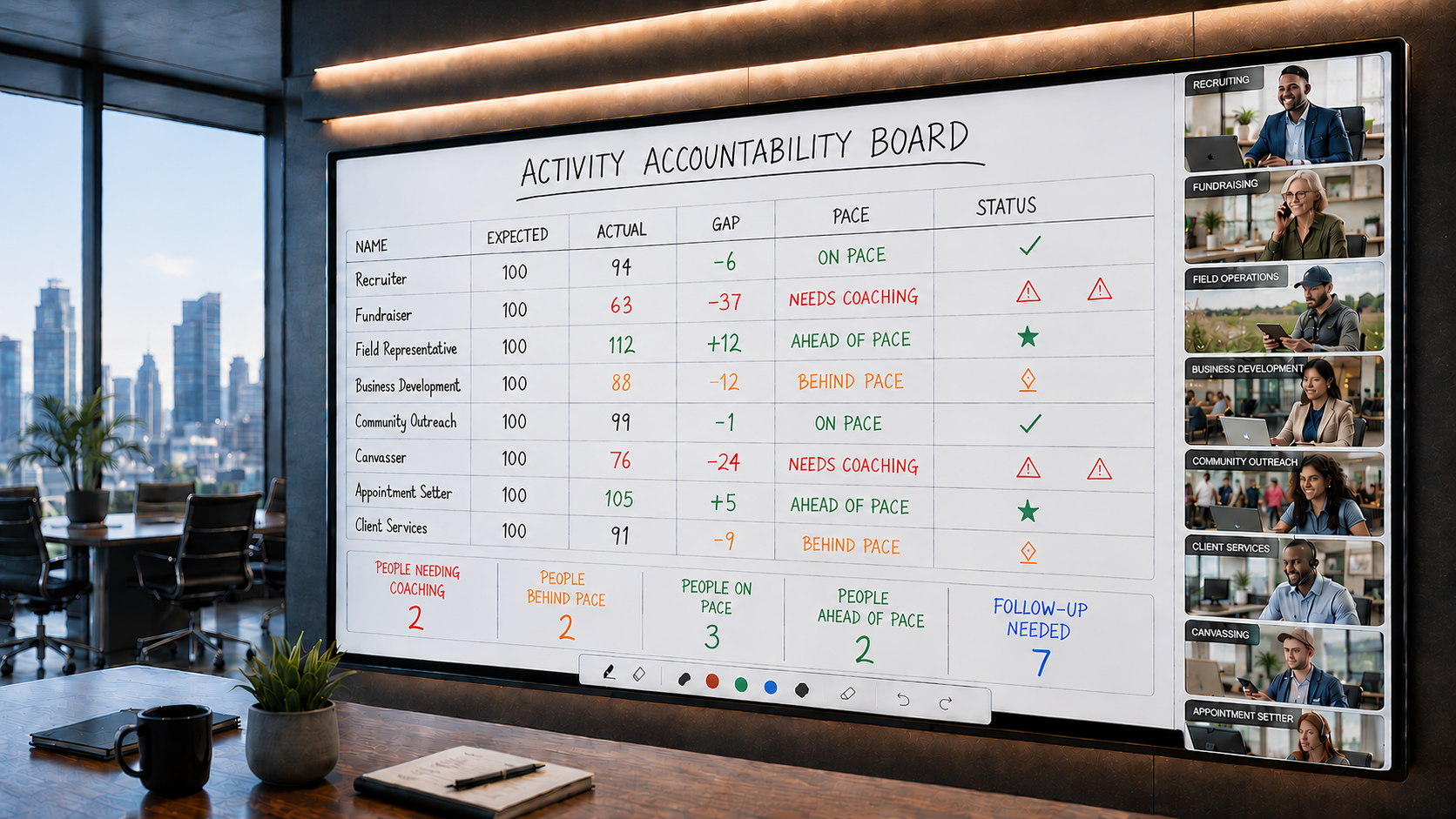
You remember what it was like when you could see.
The whiteboard. The bell. The leaderboard.
Everyone knew exactly what was happening because everything was visible.
Your team felt accountable because accountability was visible.
The important thing is that nobody had to wait for a manager to tell them they were behind.
They could see it themselves.
Their teammates could see it too.
That's what made the whiteboard powerful.
Not supervision.
Visibility.
The whiteboard created awareness.
Awareness created accountability.
Accountability created action.
Then remote happened and all of that disappeared.
Now you're back where you started.
You can't see what's happening.
Your team can't see what's happening.
And because nobody can see, nobody really knows what success looks like anymore.
Your team tells you they're busy.
They're in meetings. They're answering emails. They're on calls. They're prepping. They look productive.
But here's the question that matters: Are they busy doing the right things?
Because "busy" and "working" are not the same thing.
Busy is activity. Working is activity that creates results.
And without visibility into the right activities, you have no way to recreate that accountability that used to be automatic.
So how do you get that back? How do you rebuild what the whiteboard did, but for a distributed team?
The answer starts with understanding what "working" actually looks like in your world.
The Difference Between Busy and Working
Most leaders measure busyness by proxy.
They assume if people are in their chairs, answering emails, taking calls, attending meetings, then they're working.
But watch what actually happens.
Someone's on the phone, but they're talking to a prospect who was never qualified. Someone's in a meeting about a meeting. Someone's updating a spreadsheet from six months ago that nobody reads.
All of that counts as "busy."
None of it necessarily counts as "working."
Working is different. Working is when the activity someone does today directly creates an outcome you care about tomorrow.
It's when the rep calls the right prospect at the right time.
It's when the recruiter reaches out to a qualified candidate.
It's when the fundraiser connects with a donor who actually has capacity.
It's when follow-up happens before the prospect forgets the first conversation.
Working is activity with intent.
But here's the problem: You can't tell the difference by watching someone work.
Someone looks equally busy whether they're doing the right thing or the wrong thing.
So you need a different way to know. You need a standard. You need to know what "working" actually looks like in your world.
Expected Activity: What Does Success Look Like?
This is where most teams fall apart.
They have goals. "Hit $500K in revenue." "Recruit 20 people." "Close 12 deals."
But they don't have a definition of what activities create those outcomes.
They don't know: "To hit $500K, we need X number of activities per person per week."
They just know the target.
So when performance slips, they can't figure out why. They can't point to the activity breakdown. They just know the number missed.
Here's what happens instead:
You have a quota. Your team misses it. You react. You push harder. You motivate. You fire people up. The number doesn't change because you never understood what creates the number in the first place.
But the best-performing teams do something different.
They work backward from results.
They look at their top performers, the people who consistently hit or exceed targets, and they ask: What are they actually doing?
Not what do they say they're doing. What are they actually doing?
How many activities are they completing? How many meetings are they taking? How many follow-ups are happening? How much pipeline are they building? What's their conversion rate?
Once you understand what the top performers do, you have a benchmark.
This is exactly how high-performing organizations operate.
They don't start with averages.
They start with excellence.
The military studies successful operations.
Professional sports teams study winning teams.
Moneyball studied the players who consistently produced results and then worked backward to understand why.
The goal wasn't to copy people.
The goal was to identify the patterns that created success.
High-performing organizations do the same thing.
They identify their top performers.
They study their activity.
They establish benchmarks.
Then they use those benchmarks to coach everyone else.
That's how activity becomes intelligence.
And that intelligence serves multiple correction loops.
First, it helps people correct themselves.
Second, it helps teammates help each other.
Third, it helps leaders coach more effectively.
The goal isn't simply to give managers more information.
The goal is to create awareness early enough for correction to happen before performance suffers.
That benchmark is your "Expected Activity."
Expected Activity is: If you do these specific activities at this frequency and quality, you will hit this outcome.
And that's your definition of "working."
The Power of a Benchmark
Here's what changes when you have a benchmark.
Let's say your top performers consistently complete 100 activities a week, generate 20 meaningful conversations, and convert 4 of those into opportunities.
That's your conversion ratio.
That's your activity pattern.
That's what "working" looks like in your world.
Now you have a standard.
Now when someone's only completing 15 activities a week, you don't guess why they're underperforming.
You know.
They're not doing the activities that create results.
It's not mysterious anymore. It's not about effort or talent or "fit." It's about whether the right activities are happening at the right frequency.
The same applies whether you're managing salespeople, recruiters, fundraisers, or field teams.
The activities are different, but the principle is the same:
Figure out what your top performers actually do → Make that your benchmark → Measure whether everyone else is doing those activities.
That's how you know if people are actually working.
Actual Activity: The Gap Between What You Expect and What You See
But here's where it gets real.
Expected Activity is the target. It's what success looks like.
Actual Activity is what's really happening.
And most of the time, there's a gap between the two.
Someone's only completed 60 activities when the benchmark is 100.
Someone's converting at 8% when your top performers convert at 20%.
Someone's following up on day five instead of day one.
That gap between what you expect and what you see is where correction happens.
It's also where most teams don't look.
They look at results. "Your revenue's down." They don't look at activity. "Your call volume is down, your conversion is down, your follow-up cadence is broken."
One is a symptom. The other is the cause.
When you can see the gap between Expected and Actual, you can actually do something about it.
How to Measure Actual Activity
The challenge is: most teams can't see what's actually happening while it is happening.
You might know the team completed some activities this week. But did they complete the 35 activities per person that your benchmark requires? You don't know without asking.
You might know someone closed a deal. But how many conversations did it take? When did they first reach out? How many times did they follow up? How long did it sit in the pipeline before moving?
These details matter because they tell you whether the activity pattern matches your benchmark or not.
Traditional systems capture this data after it happens.
You get a report on Friday showing what was done that week. By then the week's over. The gaps you're seeing already cost you.
But when the gap is visible while it's happening, while the week is still alive, correction can happen.
You can see on Tuesday that someone's only completed 35 activities and needs to reach 100 by Friday.
Correction can happen in real time before the gap becomes a problem.
You can see that follow-ups aren't happening fast enough and fix it before the prospect loses interest.
You can see who's on pace and who's falling behind while there's still time to help.
That's the difference between knowing what happened and actually changing what's happening.
The Three Numbers You Need to Know
If you're going to measure whether your team is actually working, you need three numbers:
1. Expected Activity
How many activities does a person need to do per week to hit their target?
Not meetings. Not hours worked. Activities.
For a sales team: calls, meetings set, proposals sent, follow-ups.
For a recruiting team: outreach, conversations, pipeline adds.
For a field team: site visits, customer meetings, proposals.
Whatever your activity is, you need a number.
Ask your top performer: "How many of these activities do you do a week?"
That's your benchmark.
2. Actual Activity
What's really happening this week?
Not what people said they'd do. What they actually did.
How many activities? How many meetings? How many follow-ups?
The only way to know this is to measure it while it's happening, not after the fact.
3. The Gap
Expected minus Actual equals Gap.
Gap of zero? You're on track.
Gap of 10 activities? Someone needs correction as soon as it's caught so they can catch up.
Gap of 20 activities between them and the rest of the team? That's a different conversation. Something's broken: either their process, their focus, or their capacity.
But you can't fix a gap you can't see.
And that's where most organizations get stuck.
They know the benchmark.
They know the target.
What they don't have is a way to see Expected Activity and Actual Activity in real time.
They discover the gap after the week is over.
After the month is over.
After the target is missed.
Execution Intelligence closes that gap.
It makes activity visible while there is still time to self-correct, create accountability, coach, adjust, and recover.
That's the principle Wadzo was built around.
Expected Activity by itself isn't intelligence.
Actual Activity by itself isn't intelligence.
The Gap by itself isn't intelligence.
Intelligence happens when all three become visible at the same time.
That's what creates correction opportunities.
That's what creates accountability.
That's what creates performance improvement.
That's the foundation of Execution Intelligence.
Not visibility for management.
Visibility for correction.
Visibility that helps individuals self-correct.
Visibility that helps teammates create accountability.
Visibility that helps leaders coach.
Why Most Teams Don't Do This
This should be obvious, right?
Top performers do X activities. Everyone should do X activities. Problem solved.
But most teams don't actually track this.
Why?
First, they don't know what to measure. They measure results (revenue, deals closed, hires made). They don't measure the activity that creates results.
Second, they don't have a system to measure it. Even if they know they should, most managers are using spreadsheets, CRM notes, and guesswork. They can't actually see real-time activity across the team.
Third, they're afraid of looking like they're micromanaging. There's a difference between tracking activity and surveillance. Most leaders confuse the two so they track neither.
But here's what they're missing: Your team actually wants this visibility too.
When someone knows what success looks like, "I need to complete 100 activities a week," they can own it.
When they can see themselves on pace, they feel good.
When they fall behind, they can course-correct themselves instead of waiting for you to tell them they missed quota.
When activity is visible, accountability stops being something imposed from above.
The best accountability systems don't rely on managers.
They rely on visibility.
When people can see where they stand against expectations, most course correction happens naturally.
People adjust themselves.
Teammates encourage each other.
Competition emerges.
Coaching still happens, but coaching becomes support rather than enforcement.
Visibility does most of the work.
It becomes something built into the daily rhythm.
For decades, the whiteboard did this naturally.
The bell did this naturally.
The leaderboard did this naturally.
Visibility created accountability.
The challenge today isn't understanding the concept.
The challenge is recreating it for distributed teams.
And that changes everything.
What Changes When You Have These Numbers
Once you know your Expected vs Actual Activity, everything shifts.
You stop guessing about performance.
You stop reacting to results after the fact.
You stop having vague conversations about "effort."
Instead you have specific conversations:
"You're at 60 activities this week. The benchmark is 100. What's happening?"
Maybe they say: "I've been stuck on a big opportunity."
Now you can help. "Okay, let's not drop the big one, but let's also build pipeline. How do we get you to 100 by Friday?"
Maybe they say: "I didn't realize the benchmark was 100. I thought 60 was good."
Now you've found the problem. Expectation misalignment.
Maybe they say: "I'm doing the activities but nothing's converting."
Now you're looking at a different problem: quality or process, not volume.
But you can only have these conversations if you can see the data.
You can only fix what you can see.
The Most Effective Organizations
The most effective organizations don't manage outcomes directly.
They manage the activities that create outcomes.
Expected Activity creates clarity.
Actual Activity creates visibility.
The Gap creates awareness.
Awareness creates correction.
Correction can come from three places:
Self-Correction
Peer Accountability
Leader Coaching
The strongest organizations don't rely on only one of those loops.
They use all three simultaneously.
That's the foundation of Execution Intelligence.
Not visibility for management.
Visibility for correction.
Visibility that helps individuals self-correct.
Visibility that helps teammates create accountability.
Visibility that helps leaders coach.
Most organizations can tell you what happened.
Execution Intelligence helps leaders understand what is happening.
That's the difference.
One creates reports.
The other creates opportunities to intervene before performance slips.
That's the operating principle behind Wadzo.
The Real Question
The question isn't: "Are they working?"
The question is: "Are they doing the activities that create the outcomes we need?"
And to answer that question, you need to know:
1. What activities create those outcomes (Expected)
2. What activities are actually happening (Actual)
3. Where the gap is (Gap)
Once those three numbers are visible, the whole organization gets something it has needed forever:
A way to know, in real time, whether performance is on track or starting to slip.
A way to coach based on facts, not feelings.
A way to help your team stay on pace before the month ends and it's too late.
But more than that, a way to rebuild what you lost when remote work happened.
Visibility.
And with visibility comes something more powerful: automatic accountability.
Not accountability as punishment. Accountability as clarity.
When everyone can see what's happening, everyone knows where they stand.
That's what the whiteboard did. That's what you're trying to get back.
What's Next
You now know the principle.
Expected Activity is your benchmark. Actual Activity is what's really happening. The gap is where correction happens.
Once those three numbers are visible, accountability becomes automatic.
The next question is: How do you actually see this in real time? How do you know on Tuesday what's happening this week instead of Friday? How do you make this visible so your whole team can see it, the way they could see the whiteboard?
That's where an execution intelligence system becomes essential.
This is the foundation of Execution Intelligence.
Expected Activity.
Actual Activity.
The Gap.
Visibility.
Awareness.
Self-Correction.
Peer Accountability.
Leader Coaching.
Results.
When everyone can see those things in real time, performance stops being a mystery.
Read next: The Cost Of Invisible Inactivity
See Expected vs Actual Activity In Real Time
Want to see how teams use real-time visibility into Expected Activity, Actual Activity, and the Gap to stay on pace, improve performance, and rebuild the accountability that visibility creates?
→ View The Wadzo Command Center
Then, if you want to discuss how this applies to your team, book a demo.