You know you hired good people.
You remember the interviews. You remember thinking, "Yeah, this person gets it. They'll move the needle." You wouldn't have brought them on otherwise.
But now it's mid-quarter and the team's nowhere near where you thought they'd be. You're sitting there looking at the numbers and trying to figure out what went wrong.
So you do what every leader does. You pull people into conversations.
"What's going on?"
"You hitting your targets?"
"Need anything from me?"
And they all say basically the same thing: "Yeah, I'm working hard. I'm doing my best."
And maybe they are. But here's the thing you can't shake, the question you actually want to ask but somehow haven't:
How can so many people be doing so little?
Because nine times out of ten, the reason a team is underperforming has nothing to do with effort or competence.
It's because people get pulled into low-value work, distractions, side conversations, admin cleanup, inbox noise, internal meetings, and tasks that feel productive but do not actually create pipeline.
The day gets stolen in pieces.
What You've Lost
There's a reason old-school managers talk about the office like it was some golden age.
It wasn't really about proximity. It was about visibility.
You'd walk past someone's desk and see they were on the phone. You'd overhear activity. You'd see who was moving and who was drifting.
You'd notice someone making one call an hour instead of one call every five minutes. You could pull them aside and ask, "What's going on? You seem distracted."
Real-time awareness. Same-day feedback.
Nobody had to wait until the weekly one-on-one to find out something was off.
Your team felt accountable because accountability was literally visible.
Most of the time, nobody had to tell people they were behind.
They could see it themselves.
Their teammates could see it too.
That's what made the whiteboard powerful.
Not management.
Visibility.
The whiteboard created awareness before it created coaching.
People corrected themselves.
Teammates challenged each other.
Competition emerged naturally.
Managers still coached, but coaching wasn't the first line of defense.
Visibility was.
Some places had a whiteboard.
Every time someone booked an appointment, recruited a teammate, secured a commitment, raised a donation, or generated a result, they'd walk up and mark the board. Bell would ring. Everyone would look. You knew exactly who was producing and who was stuck.
It wasn't creepy. It was just... transparent.
And transparency created something important.
Awareness.
People knew where they stood.
They knew who was ahead.
They knew who was behind.
They knew when they needed to pick up the pace.
That's why the whiteboard worked.
Not because leaders watched it.
Because everyone watched it.
Visibility created awareness.
Awareness created accountability.
Accountability created action.
Coaching became the safety net, not the first response.
Then remote happened. And that transparency vanished.
Now your people are scattered across time zones, coffee shops, home offices. You have no idea what's actually happening on their end. Are they on calls? Are they checking email? Are they actually working on what matters or are they just... busy?
You wait for the numbers to come in at the end of the day, or at the end of the week, and by then it's too late to do anything about it.
The day is over.
The week is over.
The month's slipping.
The opportunities are gone.
You can't coach yesterday.
You can hopefully coach for tomorrow.
But there is no way to save yesterday once the day is already gone.
The Numbers Lie
Here's what most of us do: we wait for results and then we react to them.
Revenue's down. Pipeline's thin. Placements dropped. Closures are slow.
So we panic.
We call the all-hands meeting.
Sometimes it turns into a come-to-Jesus meeting. Sometimes it turns into a motivational pep rally. Sometimes it feels like that old sales-floor scene where the top performer gets the prize and the bottom performer gets threatened.
Everyone gets fired up for a week.
Or scared for a week.
Then things drift back to normal because you were reacting to something that had already happened instead of seeing the problem while there was still time to change it.
But there's a better question than "did they hit the number?"
It's: did they do the things that historically lead to hitting the number?
Did they make the calls? Meet with the right people? Do the follow-ups? Build the pipeline?
Because here's what nobody talks about: results are unpredictable. Activity is not.
You can't control whether someone says yes. You can't control the market or the timing or luck.
But you can control whether your team does 40 activities this week that statistically lead to results.
And if you can't see whether they're doing those activities, you're flying blind.
Busy Isn't the Same as Productive
Your team can be working all day and not move a single needle.
They're answering emails. They're cleaning up the database. They're going to meetings. They're researching. They're planning.
It looks like work. It feels like work. But it's not actually moving the ball.
Real performance isn't about hours.
It's about whether the right things are getting done by the right people at the right time with the right focus.
And for most pipeline-driven organizations, that usually comes down to two things:
Setting appointments.
Being on appointments.
Everything else may be necessary.
But those are the activities that usually move the number.
And if you can't see the activity, you have no way of knowing if that's happening or not.
So you guess. You hope. You assume people are doing what they're supposed to be doing.
Your team's underperformance isn't usually because they're not trying.
It's because you can't actually see what they're trying at. And without that visibility, you can't help them improve.
Why Your Check-Ins Aren't Working
You have one-on-ones with your people. You ask how things are going. They say "good" or "busy" or "we're working on it."
And then you move on.
But think about what's actually happening in that conversation. You're asking "do you feel okay?" and they're answering "I want to keep my job and I don't want to admit I'm struggling."
That's not feedback. That's theater.
A real conversation would look different.
It's 11 a.m.
John has made four calls in the last hour.
Yesterday, by this same time, he had made 16.
The day before, he had made 18.
His normal pace is 15 or more.
Today, he's at four.
Now the gap is visible.
John can see it.
His team can see it.
And if needed, you can send him a message.
"Hey John, what's going on? You seem off pace today."
Now correction is based on facts, not feelings or vibes.
And yes, some people may call that micromanagement.
But it isn't.
If you are responsible for driving pipeline, you are responsible for the activity that creates pipeline.
It's that simple.
If a pilot is flying from New York to Los Angeles and the plane is one degree off course, the system does not wait until landing to say something.
It corrects in real time.
Because if that course stays wrong long enough, the plane does not end up in Los Angeles.
It ends up somewhere else entirely.
That is what real-time visibility does.
It helps everyone see when the team is drifting before the destination is missed.
What Actually Happens When You Can't See
When you can't see activity, a few predictable things happen.
Your best person starts slipping. Slowly. They drop from 45 to 35 to 30. You don't notice because it's gradual. Then one day you realize they've missed their number two months in a row and you're panicking.
With real-time intelligence, you do not need to wait until the end of the week to notice the drop.
You can see it day by day, hour by hour, segment by segment.
If the standard is 12 calls an hour and your best person makes two calls in the first hour, three calls in the second, and two calls in the third, you know immediately.
They have spent three hours doing what should have taken one.
That does not mean you interrupt every dip.
Leadership still requires judgment.
You still need intuition.
But now your intuition is informed.
The person can see the gap.
The team can see the gap.
And you can decide when to step in, when to coach, and when to let the person recover on their own.
The point is simple:
You know immediately.
And because you know immediately, you can proactively change course while there is still time.
You also start managing by crisis instead of strategy. Revenue's down? All-hands meeting. "We need to focus!" Everyone works hard for a week. Then it fades because you reacted instead of coached. You didn't see the problem coming, so you can't prevent it from happening again.
And your team gets frustrated. They feel like accountability is random and unfair. They're working hard but they don't know if they're working on the right things. So eventually they stop taking ownership. They blame the market, the product, the leads. Management becomes this blame game where nobody's actually responsible for anything.
When You Can Actually See
Now imagine a different scenario.
Tom usually produces eight appointments a day.
Historically, he closes three.
His pipeline looks normal today. The number of opportunities is there. The calendar is there. The activity is there.
But by 3 p.m., something is off.
His first appointment fumbled.
His second appointment fumbled.
His third appointment fumbled.
His fourth appointment fumbled.
Now you know in real time.
Maybe it is nothing.
Maybe he is having an off day.
Maybe the quality of the appointments is different.
Maybe he self-corrects.
Maybe a teammate notices the pattern.
Maybe he needs coaching.
Maybe he needs a checkup from the neck up.
But the point is, you know while there is still time to do something.
You do not wait until the end of the day and wonder what happened.
You do not wait until Friday and review the damage.
You do not wait until the CRM tells you the result after the opportunity is gone.
You can see the pattern while it is forming.
That is the difference.
Correction becomes real.
Not "work harder."
Not "what happened last week?"
Not "why did we miss?"
Actual course correction while there is still time to change the outcome.
Why Intelligence Beats Guesswork
The best leaders don't want more surveillance.
They want more intelligence.
Think about how the world's most effective organizations operate.
The military doesn't wait until a battle is over to gather intelligence. Intelligence is collected continuously so decisions can be made while events are still unfolding.
Fast-fashion companies don't wait until the end of the season to discover what customers want. They monitor trends, buying behavior, and demand in real time so they can adjust inventory, production, and distribution before opportunities disappear.
Professional sports teams don't rely solely on final scores. They analyze performance data, tendencies, patterns, and probabilities to make better decisions while the season is still being played.
The famous Moneyball approach was not about looking only at the final score or the obvious surface-level stats.
It was about finding the individual player-level numbers that actually predicted performance.
It changed the question from, "Who looks like a great player?" to, "Which behaviors and metrics actually create wins?"
The pattern is always the same.
High-performing organizations gather intelligence. They identify patterns. They make adjustments. They improve outcomes.
Yet many pipeline-driven organizations still operate with surprisingly little visibility.
A manager may know revenue is down. A leader may know appointments are behind. A recruiter may know hiring goals are being missed.
But they often don't know why until long after the opportunity has passed.
The challenge isn't effort. The challenge is intelligence.
Who is doing the activities that lead to results?
Who is falling behind?
Where are the bottlenecks?
Which behaviors consistently produce success?
Which activities are creating momentum?
That's where visibility becomes intelligence.
And intelligence becomes action.
Sometimes that action is self-correction.
A person sees they're behind pace and adjusts.
Sometimes that action is peer accountability.
A teammate notices a gap and offers help, encouragement, or a challenge.
Sometimes that action is leader coaching.
A manager identifies a pattern and intervenes.
The important thing is that visibility creates awareness early enough for correction to happen while there is still time to improve the outcome.
That's where organizations stop managing by assumptions and start managing by evidence.
And that's the challenge many pipeline-driven organizations face today.
They have activity. They have people. They have goals.
What they don't have is a way to turn activity into intelligence while there is still time to act.
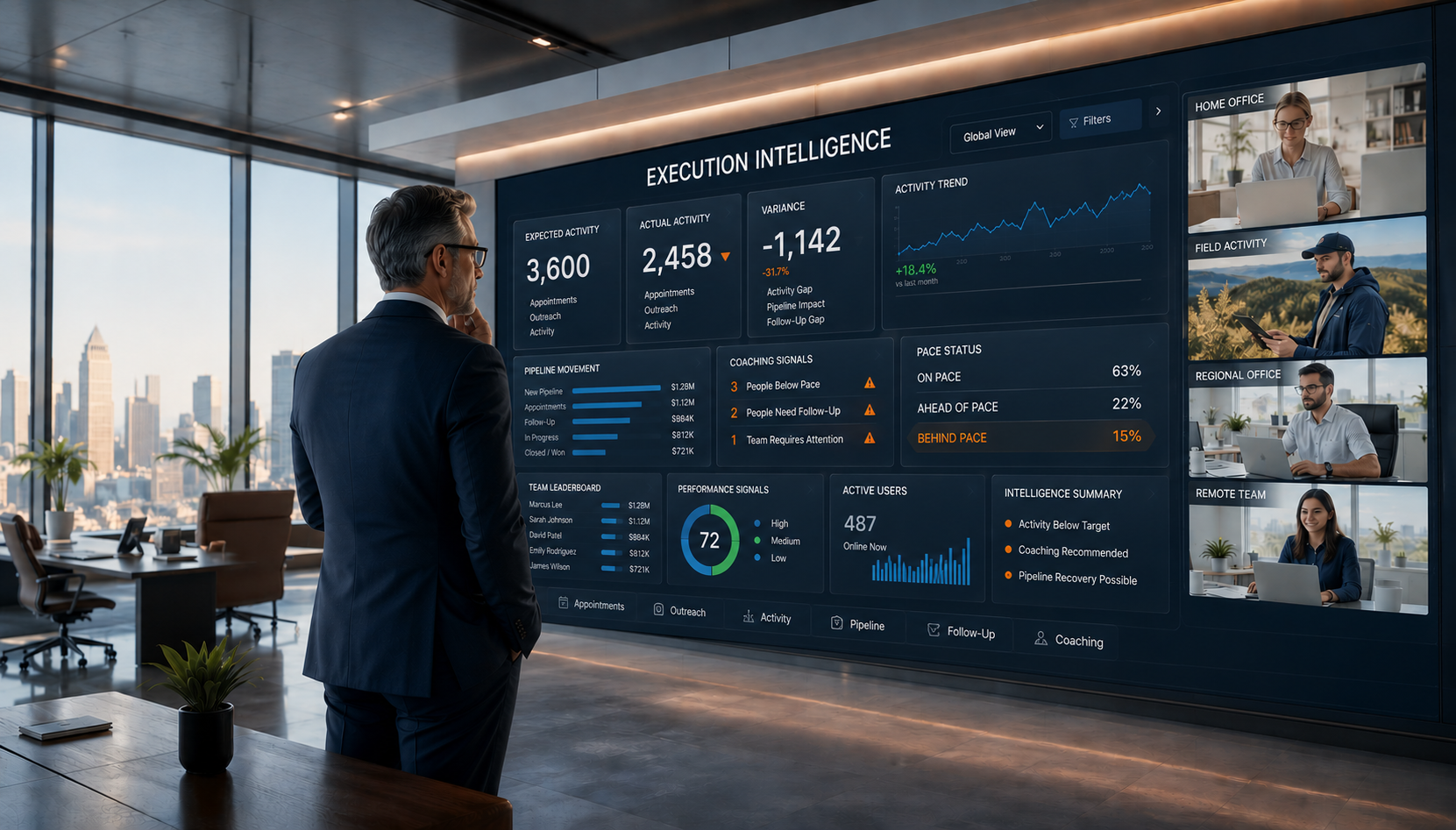
That's the gap Wadzo was built to solve.
Not after the day is over.
Not after the month misses target.
While performance can still be improved in real time.
The Framework
Most organizations manage results.
High-performing organizations manage activity.
The difference is simple:
Expected Activity: What does success look like? How many activities, what kind of activities, at what frequency?
Actual Activity: What's really happening? Can you see it in real time?
The Gap: Where's the difference? Who's on track? Who's falling behind?
Correction: Now that the gap is visible, people can self-correct, teammates can create accountability, and leaders can coach while there's still time.
Accountability: When activity is visible, accountability becomes part of the culture instead of a conversation after failure.
Results: When visibility creates self-correction, peer accountability, and leader coaching, results become easier to improve.
Most teams skip straight from "results didn't happen" to "we need to try harder." They skip the part where they actually see what's happening and fix it.
That's why they keep missing.
The Bottom Line
Your team isn't underperforming because they're not smart or not capable or not trying hard enough.
They're underperforming because you can't see what they're actually doing.
And because nobody can see it, nobody can correct it. People cannot adjust. Teammates cannot help. Leaders can only react when it's already broken.
The moment activity becomes visible, the moment you can see what's happening while it's still happening, everything shifts.
You stop managing by hope.
You start managing by what you can actually see.
Your team stops feeling randomly accountable and starts owning their results.
And performance stops being something that surprises you at month-end.
It becomes something you're actively building every single day.
What's Next
This is the first article in a series on how visibility changes the way teams perform.
Next up: How Do I Know If My Team Is Actually Working?
After that: The Cost Of Invisible Inactivity
See Activity Intelligence In Real Time
Visibility without intelligence is just surveillance. Intelligence is what turns visibility into awareness, self-correction, peer accountability, leader coaching, and results.
Want to see how real-time activity intelligence actually works? How it looks when you have the data to make decisions while there's still time to act?
→ View The Wadzo Command Center
Then, if you want to discuss how it applies to your organization, book a demo.