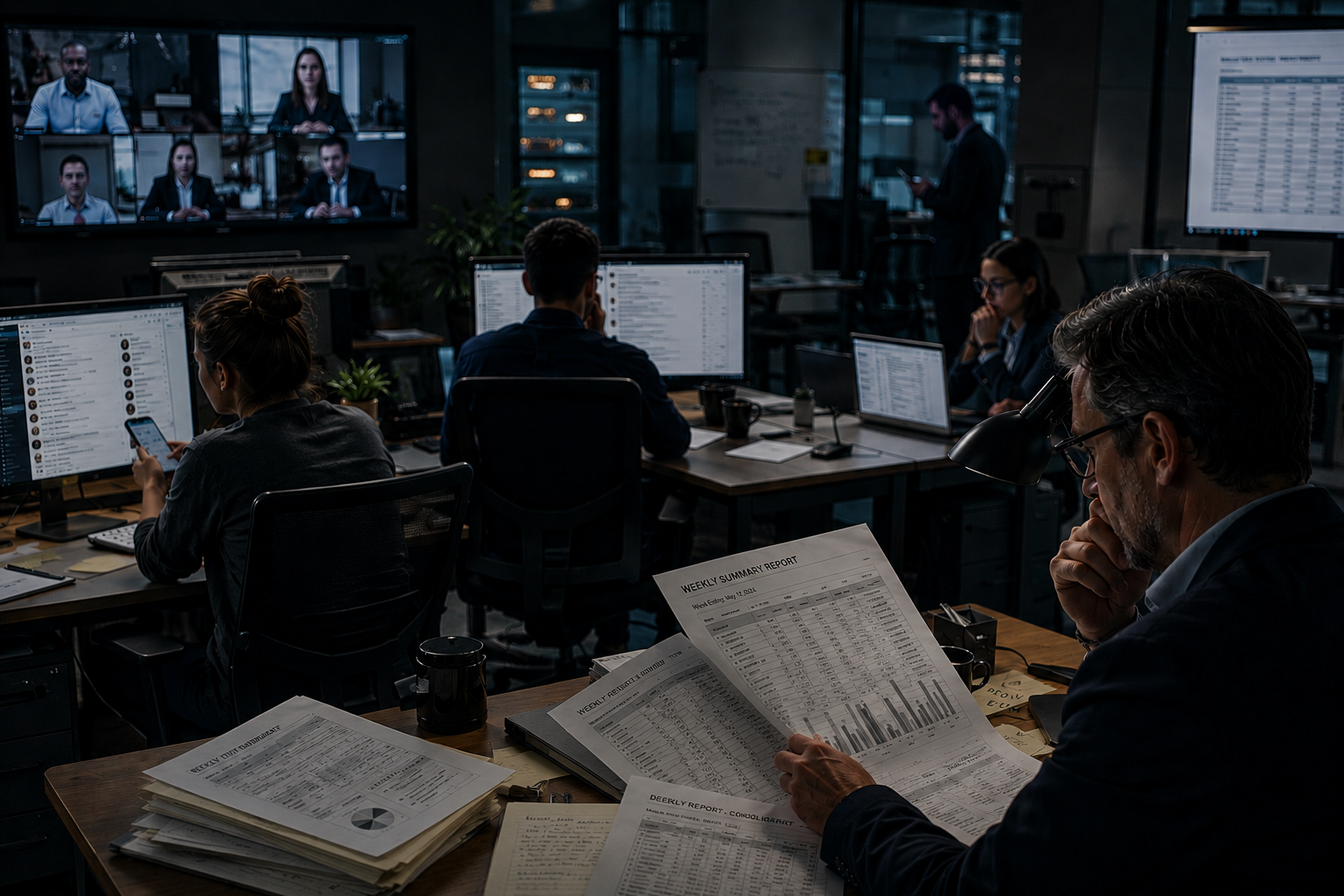
It's 2 PM on a Wednesday.
Someone on your team should be completing the core activities that drive results.
Instead, they're stuck.
They're working on something that's not moving the needle.
They've been stuck since 10 AM.
But you don't know it.
Because you can't see it.
Right now. This moment. While it's still happening.
By tomorrow morning, you'll have missed an entire day of opportunity.
By Friday, you'll look at the numbers and wonder what went wrong.
But the problem didn't start Friday.
It started at 10 AM Wednesday.
And you couldn't see it.
The Real Cost Of Invisible Inactivity
When you can't see activity in real time, you don't discover problems when they happen.
You discover them after they've already cost you.
Activity Stops
Someone stops doing the work that creates results.
Maybe they got stuck on a support issue.
Maybe they got distracted.
Maybe they're waiting for something and don't know what to do next.
The activity that drives your business just stopped.
And because nobody can see it, the normal correction that happens throughout the day never starts.
The problem remains invisible.
The Hours Pass
It's 10 AM when they stop.
By noon, two hours are gone.
By 3 PM, five hours are gone.
Five hours where the activity that creates results isn't happening.
And because nobody recognizes the problem, nothing changes.
The Day Ends
The day ends exactly the way it began.
No adjustment.
No accountability.
No correction.
The person believes they had a productive day.
The team doesn't realize there was a problem.
Leadership remains unaware.
The Week Slips
One lost day becomes two.
Two becomes a week.
A week becomes a pattern.
By the time the numbers reveal the problem, the opportunity to correct it has already passed.
The lost activity is gone.
The lost opportunities are gone.
And the week is already over.

Meetings exist.
Activity exists.
But nobody knows what is actually happening right now.
While You Were Waiting To See
Here's what was actually happening during the hours you couldn't see.
Hour 1
The board could have shown the slowdown.
The person could have seen themselves falling behind everyone else.
Nobody likes being at the bottom of the board.
A lot of correction happens simply because people can see where they stand.
Hour 2
The rest of the team could have seen it too.
Maybe it turns into competition.
Maybe it turns into trash talk.
Maybe somebody says:
"Come on, we're already at 12. You're still at 3."
The point isn't the conversation.
The point is that visibility creates pressure.
And pressure changes behavior.
Hour 4
Leadership could have noticed a developing pattern.
Not after the week was lost.
Not after the target was missed.
While there was still time to improve the outcome.
But none of that happened.
Because nobody could see the problem.
The board couldn't create pressure.
The team couldn't create accountability.
Leadership couldn't create correction.
And while visibility was missing, performance kept slipping in real time.
The Cascade Of Problems
When activity becomes invisible, problems don't stay small.
They cascade.
Problem 1: Self-Correction Breaks
The first correction loop is self-correction.
People can only adjust when they know where they stand.
When visibility disappears, people lose that awareness.
They don't know they're behind pace.
They don't know someone passed them.
They don't know the gap is widening.
So they continue doing what they're doing.
Not because they don't care.
Because they can't see.
Problem 2: Peer Accountability Breaks
The second correction loop is peer accountability.
The whiteboard worked because everyone could see it.
The leaderboard worked because everyone could see it.
The bell worked because everyone could hear it.
Competition emerged naturally.
Pressure emerged naturally.
Nobody wanted to be last.
Nobody wanted to fall behind.
When visibility disappears, that pressure disappears too.
The scoreboard is gone.
The competition is gone.
The accountability is gone.
Problem 3: Leader Coaching Breaks
The third correction loop is leader coaching.
Leaders can only coach what they can see.
When activity becomes invisible, coaching becomes reactive.
The leader doesn't see the slowdown when it starts.
The leader sees the result after the damage is already done.
By the time the pattern becomes obvious, the opportunity to correct it has already passed.
Problem 4: Results Begin To Slip
This is the part everyone notices.
Revenue drops.
Appointments drop.
Recruiting drops.
Production drops.
Pipeline shrinks.
And everyone starts looking for answers.
But the real problem started much earlier.
The correction loops failed.
Self-Correction failed.
Peer Accountability failed.
Leader Coaching failed.
The result was simply the final symptom.
The Invisible Inactivity Equation
The Cost Of Invisible Inactivity
Invisible Inactivity
↓Lost Activity
↓Lost Opportunities
↓Lost Conversations
↓Lost Outcomes
↓Lost Revenue
Most leaders only see the final result.
They see the missed target.
The missed placement.
The missed appointment.
The missed outcome.
But those results are the end of a chain.
The real loss happened much earlier.
Invisible Inactivity
↓
Lost Activity
↓
Lost Opportunities
↓
Lost Conversations
↓
Lost Outcomes
↓
Lost Revenue
That's why invisible inactivity is so expensive.
The activity that didn't happen today becomes the opportunity that never exists tomorrow.
The opportunity that never exists tomorrow becomes the result that never exists next month.
By the time leaders see the missing revenue, the missing activity is already history.
That's why high-performing organizations focus on activity first.
Because activity is where outcomes begin.
And invisible activity is where missed outcomes begin.
Most organizations can see outcomes.
Few organizations can see the chain that creates those outcomes.
That's the difference between reporting and Execution Intelligence.
Reporting tells you what happened.
Execution Intelligence helps you understand what is happening.
One explains failure after it occurs.
The other creates an opportunity to prevent failure before it occurs.
That's why visibility matters.
Not because leaders want more information.
Because people need the opportunity to correct problems while there is still time to change the outcome.
What High-Performing Organizations Do Differently
The difference between teams that perform consistently and teams that perform inconsistently isn't intelligence or effort.
It's visibility.
High-performing organizations see activity in real time.
Not at the end of the day.
Not at the end of the week.
Right now.
This hour.
This moment.
And because they can see it, people start responding to what they see:
Someone notices they're falling behind and picks up the pace.
A teammate notices and starts talking trash, creating pressure, or pushing the competition forward.
A leader notices a pattern and steps in before a small problem becomes a big one.
That's what visibility does.
It creates awareness while there is still time to change the outcome.
Someone's performance pattern changes. They see it today and adjust.
Someone gets stuck. They get help this hour instead of next week.
Someone falls behind. They have the opportunity to recover before the damage is done.
The difference between success and failure isn't what happens at the end of the week.
It's what happens during the week, in real time, while performance can still be improved.
When Every Hour Matters
Think about what happens in a single hour of invisible inactivity.
If your benchmark is five activities per hour and someone becomes stuck, that's five opportunities that never get created.
By the end of the day, that's 40 opportunities gone.
Not delayed.
Gone.
Forty chances to start a conversation.
Forty chances to move someone through the pipeline.
Forty chances to create a future result.
But the real problem isn't the missing activity.
The real problem is that nobody knew it was missing.
The person never saw themselves falling behind.
The team never saw the gap widening.
Leadership never saw the pattern forming.
The correction loops never activated.
So the slowdown continued.
Hour after hour.
Opportunity after opportunity.
Now multiply that across ten people.
Then multiply it across twenty working days a month.
The cost of invisible inactivity isn't small.
It's the difference between a team that hits target and a team that misses it.
Not because people stopped working.
Because the activity that creates results disappeared before anyone had the chance to correct it.
The Problem Isn't Your Team
Your team isn't failing because they're not trying.
The problem is that nobody can see what's happening while there's still time to change it.
The moment activity becomes visible, everything changes.
People start adjusting.
Competition starts working again.
Accountability starts returning.
Leaders gain the context they need to help.
You stop reacting to results.
You start preventing problems.
That's the difference visibility creates.
Not better reports.
Better decisions while there's still time to make them.
The Execution Intelligence Solution
Real-time visibility changes everything.
Not because it makes people work harder.
Because it gives people the chance to adjust before the damage is done.
When activity becomes visible, people start noticing things they couldn't see before.
They notice they're behind pace.
They notice someone passed them.
They notice a gap forming.
And once they notice it, they start responding to it.
The team starts responding too.
Competition returns.
Accountability returns.
People start adjusting again.
Teams start pushing each other again.
The same forces that made the whiteboard effective begin working again.
Leaders benefit as well.
Instead of discovering problems after the week is over, they can see patterns while those patterns are still forming.
The result isn't more reporting.
The result is more opportunities to change the outcome.
That's the idea behind Execution Intelligence.
Not hindsight.
Not surveillance.
Visibility while performance can still be improved.
Visibility while activity can still be increased.
Visibility while there is still time to act.
Because once the day is over, all you can do is explain what happened.
While the day is still alive, you still have the opportunity to change what happens next.
What's Next
You now understand the cost of invisibility.
The next question is:
How do you create visibility without creating surveillance?
How do you build accountability without creating micromanagement?
How do you make activity visible while the day is still alive?
That's where Execution Intelligence begins.
Read next:
You Can't Coach Yesterday
See Real-Time Activity Intelligence In Action
Want to see how teams use real-time visibility to identify gaps while there's still time to change the outcome?
How visibility creates awareness, accountability, and correction before missed activity becomes missed results?
→ View The Wadzo Command Center
Then, if you'd like to discuss how this applies to your team, book a demo.